"Sense and Simplicity" as it says in the image!
They must be talking about simple sensible safe and easily made incandescents?
The above image is from the Foundry, at Heritage.org, thanks...
I told them about my post on Philips, Osram and the UN en.lighten program,
and I now see they happened to have an article on the same topic the day after without any reply or credit (and it was not a topical news item, covered by anyone else at the time) - though in fairness it's a well laid out summary of the issues.
Given the number of recent posts about Philips on this blog,
it might seem that I have something against them.
Actually it's rather the news, reports and research that keep coming up about Philips.
Regarding the LED prize 50 dollar bulb,
covered in this earlier post, the reported comment by a Philip Premysler (Philip's take on Philips!) was particularly interesting in its thoroughness.
He has since updated this with some more information,
íncluding a reference list with further links regarding Philips lobbying, not just for the LED prize, but also with respect to Philips supporting the ban on unprofitable simple incandescents

• In 2007, Phillips Holding USA Inc. Spent At Least $418,446 Lobbying The Department Of Energy On H.R. 6.
(Senate Office Of Public Records, Lobbying Disclosure Form, 8/01/07; Senate Office Of Public Records, Lobbying Disclosure Form, 2/14/08)
• Philips Spent An Additional $160,000 Lobbying Congress On H.R. 6 Through Paul, Hastings, Janofsky & Walker LLP.
(Senate Office Of Public Records, Lobbying Disclosure Form, 8/8/07)
also, from the quoted article by Bill Mc Morris...

Philips received about $5.6 million from the federal stimulus to advance its LED lighting technology.
It spent nearly as much—$4.5 million since 2008—lobbying Congress and the Obama administration for bills friendly to lighting appropriations.
For completeteness,
the whole updated statement by Philip Premysler, relating to the LED prize
(author's emphasis in capital letters, my highlights in bold style):
There are greater troubling issues beyond the price.
The problem is that the L-Prize contest which was supposed to foster U.S. green technology competitiveness was RIGGED.
As a foreign based (headquartered) corporation Philips was excluded from eligibility according to the law that established the L-Prize, in particular public law 110-140 section 655(f)(1).
Under U.S. federal law the term “a primary place of business” used in the statute refers to the single headquarters location, which in the case of Philips is Amsterdam, Netherlands.
Philips, of course, would have known that they were ineligible, so they put out PR flak alleging that the bulb was the result of a global effort. The truth, as evidenced in Philips patent on the bulb, is otherwise.
See Philips L-Bulb Patent.
The bulb was developed in the Netherlands: The patent application which was, originally filed in Europe in 2008, but published in the U.S. two months after the Philips executive made his misrepresentations, lists only Dutch inventors, no U.S. inventors and assignes the patent to the Dutch Philips entity, not to a U.S. entity.
When this issue arose after the announcement of Philips as the L-Prize "winner",
the CEO of Philips Lighting North America Zia Eftekhar went on record falsely stating that the L-Prize bulb was "conceived" and had its "origins" in the U.S.
See EE Times article
[Quoting the article:
"But what about the development of the bulb, and where will it be manufactured?
Zia Eftekhar, CEO of Philips Lighting North America, wanted to set the record straight:
He told me the L Prize bulb “..was conceived, designed, and will be manufactured in the United States.... He repeated this for emphasis: “The origins and development of this product, as well as its future manufacturing are all in the United States."]
These were falsehoods.
In fact Philips' L-Prize entry was invented by three dutch inventors and assigned to Philips of the Netherlands. [As from patent document previously mentioned]
Philips also spent $1.79 Million lobbying for appropriation for the L-PRIZE,
(as referenced, including from Senate Office Of Public Records, Lobbying Disclosure Forms).
Moreover, "A House Appropriations Committee report issued in June slammed the department for announcing the $10 million prize without prior approval from Congress." (Washington Beacon article by Bill McMorris)
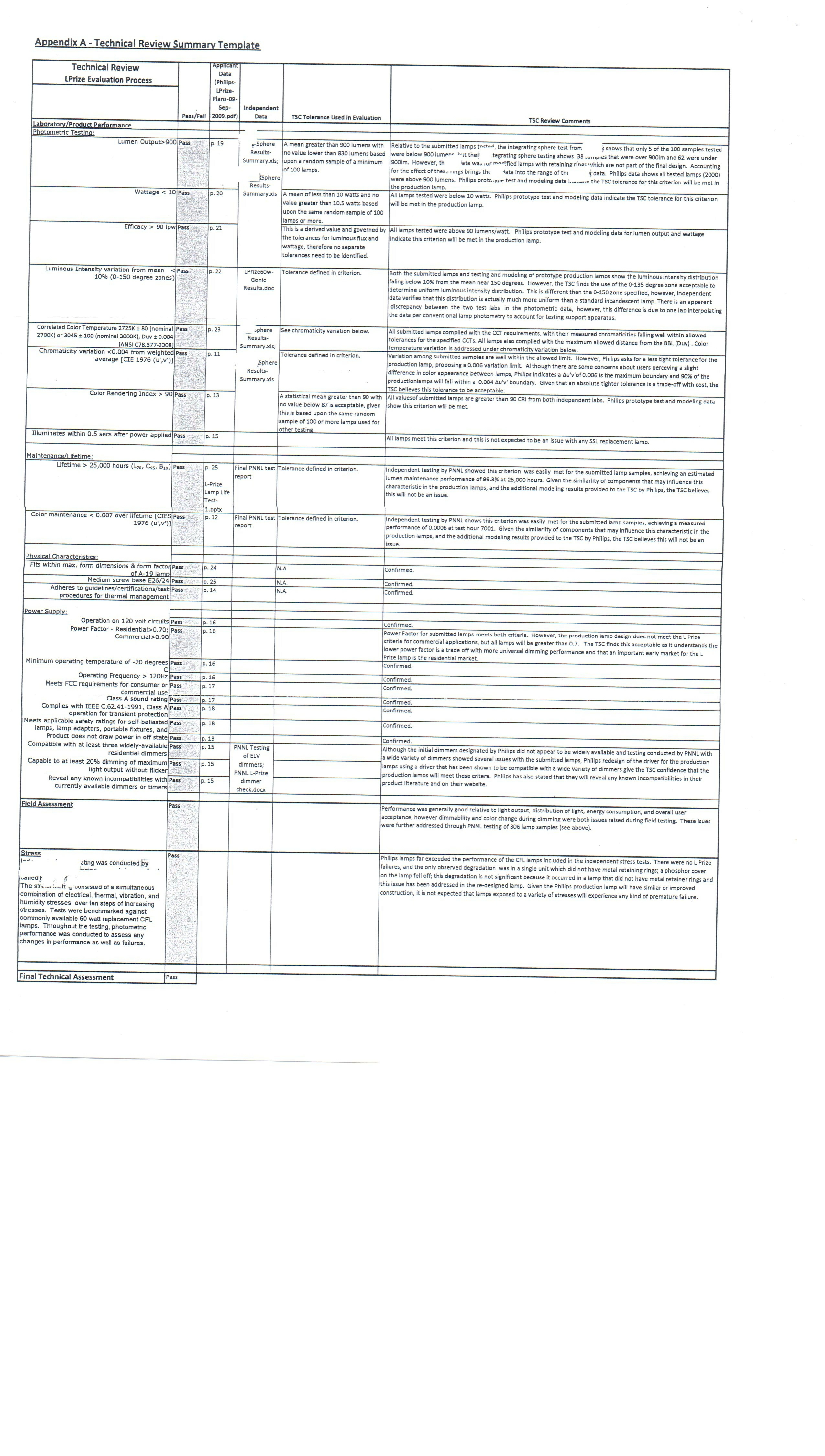
The L-Prize entry also failed to meet key technical requirements of the contest. The Philips entry does not meet the stated uniformity requirement of the contest. This is admitted in a document [in its review comments] obtained under the Freedom of Information Act, see http://tinyurl.com/43ECMQM
[alt link to the document source here, easier magnifiable document copy here (click on it to enlarge)].
The curt justification asserted in that document based on comparing uniformity to a standard incandescent lamp is factually (quantifiably) false. The putative L-Prize winner is actually less uniform.
The Philips entry also failed to produce the required amount of light.
In one test 62 out of 100 bulbs failed (see the above linked document).
Whether the commercialized version will consistently produce the required amount of light is an open question [ed- unlikely given that the commercial version is not as good see above]. HOWEVER the stated procedure for the contest was that if the entry failed a required test, the entry would fail.
What happened is that Philips wanted prematurely to claim the prize
(as in Reason.com article) and the Department of Energy did not want to follow the rules and fail them, rather they embarked on RIGGING the contest. They kept the failure secret and proceeded with other tests.
[ed- more on the testing debacle below, also see the comments below to this post]
The result is that a bulb developed by Dutch inventors, built with some (possibly most) of its parts made in Shenzhen China (see http://www.dailytech.com/Philips...) has been given a great initial advantage which may allow it to dominate U.S. competitors, even though the contest is RIGGED.
We may wind up with Dutch citizens enjoying social welfare benefits such as vacations for the unemployed, supported by Chinese workers working 12 hours a day and American consumers squeezed by $50 light bulb prices whether they pay that amount at the check out counter or indirectly pay for subsidies through their electric bill [ed- including the currently planned taxpayer subsidies passed on to stores for price reductions at point of sale].


 The Missouri light bulb bill was favorably passed in the House Small Business Committee on April 4th.
 Just learned that Missouri local state Rep.