If energy needs to be saved, there are good ways to do it.
                                                               Government product regulation is not one of them

Showing posts sorted by relevance for query heatball. Sort by date Show all posts

Tuesday, August 28, 2012


Heatballs are Dead...
Long Live Special Lamps!


Given the canned bulb "culture reserve" memorial as per recent posts, rather co-incidental to see the Heatballs getting the same fate, as quoted below, with my emphasis.

[In summary, the Heatball venture was a satirical gesture against the light bulb ban, turning the "95% heat waste" jibe around to therefore justify the sale of the incandescents as heat bulbs rather than light bulbs. The courts did not approve, believing that "misuse" was likely and that they were sold "with false product information" as to their likely use.]


Fazit ist, dass die Heatballs 2nd Edition in 75~W und 100~W, matt und klar wegen möglicher Fehlanwendung durch den Verbraucher und den damit verbundenen Gefahren für nachfolgende Generationen unter Verschluss bleiben. Wir halten eine weitere Klage vor dem OVG in Münster für aussichtslos und haben uns daher entschieden, die Heatballs der 2nd Edition als Kulturreserve einzulagern und Museen als Ausstellungsstücke zu überlassen.

The bottom line is that the Heat Balls 2nd Edition in 75W and 100W, frosted and clear, because of possible misuse by the consumer and the associated risks for future generations [ed- irony] remain blocked. We hold another appeal to the Higher Administrative Court in Münster to be futile and have therefore decided to store the [rest of] the 2nd edition Heatballs as a cultural reserve, to be passed on to Museums as exhibits.

Nevertheless, they did get recognition of Heat balls as potential "special lamps".
But selling them as a way to get round the ban did not please the authorities.
So in a change of tactic, a serious marketing venture will be launched using the website
ewg-eg.de   Elektrische Widerstandsgenossenschaft eG, "Electrical Resistance Cooperative".
Rather than a satirical sale of Heat Balls, a serious sale of Special Lamps...well, maybe not completely serious (the packaging here is not necessarily relevant!)


Comment

The Heatball story is not as straightforward as might appear...

As covered in recent news stories, such as by the British newspaper The Daily Telegraph, "rough service" bulbs are being sold legally in the EU.
It so happens that the last Heatballs from China were of this or similar type i.e. unlike the first Heatball bulb types, they were being legally sold by others as light bulbs!
In other words the supposed "misuse" of the bulbs would result in perfectly legal, ordinary use,
while their use for heating was never challenged legally (whatever practical reservations may have been felt about it, as in the EU response on the matter).

It's as if a drinking straw was sold to stir drinks with, but forbidden because it might be "misused" in that people might actually drink through it!


Unsurprisingly, Drs. Rudolf Hannot and Siegfried Rotthäuser behind the venture felt there could have been political pressure involved in the decisions.
The "special lamp" status for use as heating is legal enough, but the satirical campaigning of it as a way to get round the EU ban worked against them.

Turning the tables on the authorities, who after all seem very safety conscious, they enquired as to the measured mercury content values of previously suspected fluorescent lamp types...
receiving the unsurprising answer that this had not been checked. No worries there, then.

Meanwhile, their venture into selling light bulbs is therefore not over.
The new Electrical Resistance Cooperative will as said sell "special lamps" as well as generally campaign against light bulb regulations, membership is 100 Euro.


Zwöfter Heatball Newsletter
Kulturhauptstadt 2010 Essen
2012-08-26


Liebe Heatball Freunde,

am 19.06.2012 haben wir in Aachen vor dem Verwaltungsgericht in der
Hauptverhandlung um die Zukunft des Heatball gekämpft.

Mittlerweile liegt das Urteil auch schriftlich vor und kann auf unserer
Webseite im Aktionsverlauf studiert werden.

http://www.heatball.de/pdf/VG_Aachen_Urteil_2012_06_19.pdf

Facit ist, dass die Heatballs 2nd Edition in 75~W und 100~W, matt und klar
wegen möglicher Fehlanwendung durch den Verbraucher und den damit verbundenen
Gefahren für nachfolgende Generationen unter Verschluss bleiben. Wir halten
eine weitere Klage vor dem OVG in Münster für aussichtslos und haben uns daher
entschieden, die Heatballs der 2nd Edition als Kulturreserve einzulagern und
Museen als Ausstellungsstücke zu überlassen.

Zitat aus der Ordnungsverfügung:

... liegt die Anordnung der sofortigen Vollziehung auch deswegen im
besonderen öffentlichen Interesse, da nach Artikel 20a GG der Schutz der
natürlichen Lebesgrundlagen im Vordergrund stehen muss ...

Nachdem nun erneut Warnungen zum Thema Energiesparlampe ergangen sind, hatten
wir bei der Bezirksregierung als zuständige Marktüberwachung nach den
Quecksilberwerten beanstandeter Energiesparlampen gefragt.

Originaltext: Deutsche Umwelthilfe e.V.
Digitale Pressemappe: http://www.presseportal.de/pm/22521
Pressemappe via RSS : http://www.presseportal.de/rss/pm_22521.rss2

Antwort der Bezirksregierung:

>
>Von: Bensberg, Claudia [mailto:claudia.bensberg@bezreg-koeln.nrw.de]
>Gesendet: Mittwoch, 8. August 2012 12:49
>An: Hannot, Rudolf
>Cc: Ledwig, Thomas; Goeble, Sascha; Brosius, Karl
>Betreff: AW: Deutsche Umwelthilfe stoppt erneut Verkauf von ...
>
>Sehr geehrter Herr Dr. Hannot,
>
>leider liegen uns die von Ihnen gewünschten Werte nicht vor.
>
>
>Mit freundlichen Grüßen,
>im Auftrag
>
>Claudia Bensberg
>
>Dezernat 55
>Produktsicherheit/Sprengstoff
>
>
Soviel zum Thema Artikel 20a Grundgesetz. Doch es gibt auch Hoffnung. In
der Verhandlung haben wir das Thema Speziallampe noch einmal darstellen können
und hierzu den Heatball 2.0 demonstriert. Aus der Veredlung einer anerkannten
Speziallampe ist dieser hervorgegangen und liegt nun seit Monaten bei der
Marktüberwachung zur Begutachtung vor, ohne Reaktion.

Sehr wichtig für eine Speziallampe ist, dass diese mit der richtigen Gesinnung
vertrieben wird. Sobald der Verbraucher durch eine satirische Aussage dazu
verleitet wird, die Lampe nicht entsprechend des angegebenen
Verwendungszweckes zu nutzen, ist diese keine Speziallampe mehr.

Der juristische Dienst der EU-Kommission hat klargestellt, dass die Erklärung
des Herstellers und der Hinweis, dass das Produkt nicht zur allgemeinen
Raumbeleuchtung geeignet ist, ausreichen, um eine Speziallampe zu
erhalten. Beim Heatball 2nd Edition ist es aber eine Gesinnungsfrage, die über
den Titel Speziallampe entschieden hat, allen physikalischen Fakten und der
Verordnung selbst zum Trotz.

Vor Gericht wurde uns durch die Bezirksregierung versichert, dass es derzeit
keine akuten Bestrebungen gibt, den Heatball 2.0 zu verbieten und man auf eine
Stellungnahme der Ministerien warte.

Da nun der Herbst naht und viele Besitzer von Niedrigenergiehäusern den
Vorteil der Speziallampe Heatball nutzen möchten, haben wir beschlossen, dass
wir eine erste Charge entsprechend der nicht beanstandeten Warenproben, die
der Bezirksregierung vorliegen, in Auftrag zu geben.

Sobald diese Speziallampen verfügbar sind, werden wir sie über die Seite der
Elektrischen Widerstandsgenossenschaft eG www.ewg-eg.de humorlos und mit
technisch nüchterner Gesinnung anbieten. Die Satireseite www.heatball.de wird
als Erinnerung an das Widerstandsprojekt online bleiben aber keinen Shop mehr
haben.

Da wir uns nun am 1.9 von den letzten Glühbirnen verabschieden müssen, hat die
Presse das Thema auch wieder aufgeriffen. In der Sendung markt im WDR
Fernsehen läuft am Montag, 27.8 um 21:00 ein Beitrag, in dem Heatball
mitwirkt.

..........................

Mit vorherbstlichen Grüßen

der Vorstand der EWG eG

R.Hannot
S.Rotthäuser


Sunday, February 5, 2012

We want to shed more heat than light!


There has been more activity around the "Heat Balls" of late, that is, the German attempt to circumvent the EU light bulb ban law by importing and selling the incandescent bulbs as heating devices - more on the background of it below. Most of their information is in German, but those who want can use for example Google site and text translation.

Recently, a large bulb shipment that had been declared illegal was released from impoundment at customs.
More about that seizure can be read in the English language Local.de article of about a year ago
In what was meant to be a humorous protest of the European Union’s phaseout of conventional bulbs, DTG Trading owner Siegfried Rotthäuser ordered 40,000 of them in November from China. He intended to skirt regulations by selling the 75- and 100-watt strength bulbs as a source of heat for what his website calls a “resistance art project.”

However, they can't sell those ones, as they are still subject to the court decision against them (as described before).
They are nevertheless selling some lower wattage bulbs - 60W clear type for 1.69 euro each including a 30 cent rain forest charity donation, plus postage charges.
[Not sure even that is entirely legal, as regular 60W bulbs are banned from 1 Sep 2011 (EU technical specs, scroll to end), and they do not appear to be a possibly exempted "rough service" types which may last longer, but are dimmer.]

They recently answered a customer enquiry this way:
"You can (at this time) order 60W crystal only, other types are banned by the local government. The expected life time was 2000h, but realistic is about 1500h."


As for the legal situation,
the EU Commission have further clarified their opinion on the matter.
Their basic position was made clear a year ago.
It's all in German and image-copied, so no online translation.
However it is the usual "Hey we all save the energy of Romania" carry on (the Romanians must be very happy by now!) so not really worth wasting time on anyway...

That said, as also reflected in the original court decision, one point related to the necessary labelling of the bulbs as being "unsuitable for lighting".
There is a kind of trap the EU is falling into, as they themselves have pronounced the lamps as unsuitable for lighting.
So the Heatball people sought clarification on this, and the EU Commission in a November 2011 letter (in German) says they are right, that the labelling would legalize the bulbs under EU legislation 244/2009 Article 3 paragraph 2.
As always there is a proviso, in that the Commission suspects that in their legal quest the Heatball people will still have to show that the bulbs will not likely be "misused" as lighting, and that the Heatball company's own (current) promotion language in selling the bulbs would likely be taken into account in that regard.

The Heatball "user info" is taking the above into regard, and again emphasizing the overall environmental benefit of the lamp. The latter is also taken as shown by referring to Dr Peter Kosack's Kaiserslautern University research (in German) comparing infra-red with conventional room heating, and the relative advantages of the former....from the research findings:
It was shown in the present study, that infrared radiation heating is a viable alternative to conventional heating systems.
With proper use of infrared radiation heating, there are advantages in energy consumption as well as in lowered CO2 emission and overall cost.
[as seen from other incandescent related heating studies, the CO2 reduction is particularly noteworthy when the electricity source is low in C02 emissions, eg nuclear, hydroelectric, wind, solar, and in turn displaces oil/gas/coal/turf/ home heating]

So, 28 January 2012, in the latest Heatball newsletter...
"The Higher Administrative Court in Münster will hopefully express an opinion in the near future, paving the way for the pending trial before the administrative court in Aachen."


A new cooperative:
They have also started cooperative for those who want to get lamps not meeting EU standards.
This is also "in the field of education on the topic of light and heat" and aims to get "more weight in the political debate" .


A continuing art-environmental protest:
So, rather than being a commercial activity, the founders, engineers Siegfried Rotthäuser and Rudolf Hannot continue to emphasize that in their view it is a sort of art-environmental protest against pointless EU laws. As they said last week:
"Heatball is a kind of art. It a satiric project against undue laws.
The project shows how to do something for the rainforest quite easily."
An early Reuters article by Michelle Martin, October 2010,
also points this out...
German "heatball" wheeze outwits EU light bulb ban

(Reuters) - A German entrepreneur is bypassing a European Union ban on light bulbs of more than 60 watts by marketing his own brand as mini heaters.

Siegfried Rotthaeuser and his brother-in-law have come up with a legal way of importing and distributing 75 and 100 watt light bulbs -- by producing them in China, importing them as "small heating devices" and selling them as "heatballs."

To improve energy efficiency, the EU has banned the sale of bulbs of over 60 watts -- to the annoyance of the mechanical engineer from the western city of Essen.

Rotthaeuser studied EU legislation and realized that because the inefficient old bulbs produce more warmth than light -- he calculated heat makes up 95 percent of their output, and light just 5 percent -- they could be sold legally as heaters.

On their website (heatball.de/), the two engineers describe the heatballs as "action art" and as "resistance against legislation which is implemented without recourse to democratic and parliamentary processes."

Costing 1.69 euros each ($2.38), the heatballs are going down well -- the first batch of 4,000 sold out in three days.

Rotthaeuser has pledged to donate 30 cents of every heatball sold to saving the rainforest, which the 49-year-old sees as a better way of protecting the environment than investing in energy-saving lamps, which contain toxic mercury.
A German 2010 article has further background information.


They were also part of the Austrian film Bulb Fiction, highlighting some of the faulty arguments and industrial politics behind the EU ban (I have been meaning to do a separate post about the film).

Here are "all the lads" behind the two ventures...

Rudolf Hannot (Heatball), Christoph Mayr (Bulb Fiction), Siegfried Rotthäuser (Heatball),
and Moritz Gieselmann (Bulb Fiction)

More photos in this Austrian Film photographic archive, and video clip links etc.


# # #
Past blog posts about Heat balls are copied below for convenience
[Some of the above 2011 information was not made available earlier]
# # #

Update December 14 2011

As the USA ban is coming up, and continuing with a comparative look at how Europeans have thought up ways around the regulations, the attempt to sell 90% heat emitting products as "heat balls" was interesting and imaginative.

Needless to say, the legal heads were not amused...

They have for the last months been considering an appeal in a higher court and how to go about it.
Meanwhile, in September they tried to have the Heatballs sold in Switzerland (outside the EU) but in October this got a definite no from the Energy ministry official responsible for Energy Efficiency legislation.


# # # # # # # #

Update July 27 2011:

As expected, the decision yesterday (26th July) was that the "heat balls" can not be allowed, in also being a source of light as banned by specifications throughout the European Union
(the name "heat balls", also using English in Germany, was presumably to take away from the light "bulb" idea). More here.

The case was not altogether clear however: So-called "rough service lamps" as used in mines and other such locations are also incandescent lighting as banned in the EU specifications, and there are other exemptions as for small refrigerator lamps and the like.

The issue therefore turns around lighting used as GLS (general service lighting) in ordinary ceiling fittings etc.
So the prospect of, in practice, identical general service lighting being continued was obviously too much:
There might have been (= might be) more chance of success if the light bulbs had a specific screw-in fitting for a lamp with say a reflector in it to "beam the heat".
Of course, enterprising (and determined) people would then put such fittings also in other lamps, but that is another matter...


# # # # # # # #

June 28 original post

Siegfried Rotthäuser and friends in Germany have imaginatively tried to get round the European ban on regular simple incandescent bulbs by marketing them as "Heat Balls" (more).
This is a sop to the frequent ban defence relating to the fact that incandescent light bulbs give out over 90% of their electrical energy they use as heat (nevertheless being much easier to manufacture, when great brightness is required, compared to CFLs or, even more so, compared to LEDs).

The case has gone to the courts for decision, expected 26 July 2011, see announcement (pdf, in German)


Comment
Interesting legal argumentation might be expected in court...
a heat ball or rather "heat bulb" market idea to be followed in the USA and elsewhere?

As for light bulb heat "waste", it is often conveniently forgotten that CFLs and LEDs also convert most of their energy use to heat, although the heat is internalized more - in the case of CFLs leading to a recognized fire risk.
More on incandescent light bulb heat, and it's possible benefit here (http://ceolas.net/#li6x)


// end June 28 post
Regular update posts in this blog, search on "heat balls" //


Footnote:
"To shed more heat than light", for those who do not know, is an English expression meaning to stir up emotions (heat), cause controversy and confusion that makes an issue less clear...
"EU Commission": More politically correct "the European Commission", but I do not subscribe to their nomenclature (or much else that has to do with the EU, for that matter)


Friday, June 29, 2012

Feeling the Heat: Heatball Update


The German satirical (but as it turns out, seriously undertaken) attempt at circumventing EU light bulb laws by marketing incandescent bulbs as "Heatballs" has been well covered in previous posts here, as can be seen using the search functions on the left.
The major explanatory post is "We want to shed more heat than light!".

In the ever-ongoing legal battle, the most recent decision of the local Aachen court 19th June 2012 has gone against them...though "leave to appeal" to the regional Münster court has again been given (keeping lawyers in clover).

The last newsletter message from Heatball, June 3, sets up the situation, translated roughly by Google translation further below. I corrected a little to get the gist of it across, might correct a bit more if time (German to English and vice versa particularly problematic for translation tools, given word order issues!)


Liebe Heatball Freunde,
die Elektrische Widerstandsgenossenschaft eG wird am 19.06.2012 wieder in Aachen vor dem Verwaltungsgericht in der Hauptverhandlung um die Zukunft des Heatballs kämpfen.
Was hat sich alles getan?
Im letzten Sommer hatten wir das Eilverfahren in Aachen verloren, doch seitdem hat sich einiges verändert. Das Oberverwaltungsgericht in Münster hat nun festgestellt, dass die Heatball Aktion keine Kunst ist; nun ja im Urteil des Berliner Kammergerichtes heißt es dagegen, dass der "durchschnittlich informierte Verbraucher" die Aktion als solche durchaus erkennen könne; alles eben eine Frage der Sichtweise.
In der Urteilsbegründung im Eilverfahren des VG (Verwaltungsgericht)-Aachen war die mangelnde Verbaucherinformation als Grund angegeben worden, warum der Heatball auch keine Speziallampe sein kann. Diesen Missstand hatten wir direkt nach Bekanntwerden geheilt.
Das Finanzgericht in Düsseldorf hat im Frühjahr zu unseren Gunsten entschieden und festgestellt, dass die Beschlagnahmung der Heatballs am Flughafen nicht Rechtens war. Der für die Genossenschaft entstandene Schaden durch die unnötige und rechtwidrige Zwangseinlagerung, die auf Betreiben der Bezirksregierung durch den Zoll erfolgt ist, wird uns allerdings nicht erstattet; diesen müßten wir einklagen.
Mit viel Geduld ist es uns nun gelungen, dass auch der juristische Dienst der EU-Kommission eine Stellungnahme zur Definition einer Speziallampe abgegeben hat. Wenn sich das VG-Aachen in der Hauptverhandlung hieran hält, dann dürfte dem Heatball der Titel als Speziallampe zustehen und die Ordnungsverfügung könnte aufgehoben werden. Dies wird aber aus politischen Gründen nicht passieren dürfen.
In unserem Shop haben wir derzeit Lampen der Firma Philips, die als Speziallampe anerkannt sind. Die Bezirksregierung hat prompt hiervon Warenproben genommen, die sie nicht beanstandet hat. Baugleiche Lampen waren von uns bereits in Aachen beim Eilverfahren gezeigt worden, um auf die Möglichkeiten einer Speziallampe hinzuweisen. Diese Produkte werden offensichtlicherweise von der Bezirksregierung nun als rechtskonform angesehen.
In Folge dessen werden wir nun in der übernächsten Woche die Produkte Workball
und Heatball 2.0 auf den Markt bringen und gleichzeitig der Bezirksregierung Warenproben sowie Verbraucherinformationen zukommen lassen. Da diese Produkte identisch zur Philips Speziallampe sind, würde uns die Begründung eines Verbotes sehr interessieren.


Heatball friends,
the electrical resistance is fighting on 6/19/2012 eG again in Aachen before the Administrative Court at the trial about the future of the Heat ball.

What has done it all?

Last summer we lost the fast track in Aachen, but since then a lot has changed.
The Higher Administrative Court in Münster has determined that the Heat ball action is not art, against the judgment of the Berlin Chamber Court that stated that the "average informed consumers" can see the action as such, certainly, all just a matter of perspective.
In the judgment of the VG(Verwaltungsgericht)-Aachen court, the lack of information for consumers was given as a reason why the Heat ball can not be a special lamp. This grievance we immediately fixed after the announcement.

The Tax Court in Duesseldorf in spring decided in our favor,
and found that the seizure of the Heat balls at the airport was not rightful. The resulting damage to the cooperative by the unnecessary and unlawful coercion storage, done at the behest of the District Government through customs, has not been refunded, which we have had to complain about.

With patience, we have now succeeded, that the legal departments of the European Commission have given opinion on the definition of a special lamp. If the VG-Aachen holds thereto at the coming trial, then the Heatball definition as a special lamp is expected and the public order could be lifted. For political reasons this will hardly be allowed, however.

In our shop we currently have lamps from Philips, recognized as a special lamp.
The district government has taken samples from us, but that status has not been challenged. Identical lamps had been already shown by us in Aachen in summary proceedings, to indicate the possibility of recognition as a special lamp. These products are obviously considered by the district government as legal.
As a consequence, we are now in the next week bringing out the products Work Ball and Heatball 2.0 to the market and will at the same time send samples to the district government including the consumer information. Since these products are identical to Philips special lamps, we would be very interested in any reason for a ban.


The local Aachen paper set the stage just before the court decision, article, June 18.
Article translated by Google, here.

German Zeit paper on decision, 19 June article, Google translation.

Quoting and expanding on the articles, according to current and preceding judgements, the 95% heat of the bulbs does not make them into "small heaters":
Engineer Dr Siegfried Rotthäuser and his physicist colleague Dr Rudolf Düren Hannot who are behind the Heatball action have evaluated the action as a success nonetheless.
"We have attracted attention. Now deal with the other criticisms of the incandescent ban."


As scientists, they doubt the environmental effect of the banishment of the "small, innocuous" light bulb - and they see themselves as eco-friendly, with 30 cents from each sale going to a rainforest project.


More from Dr Hannot in an earlier article, Google translation... and he is not the first physicist to criticize the token light bulb bans (eg http://ceolas.net/#li6x, http://ceolas.net/#li171x)
"They (the ruling politicians) dedicate themselves to energy-saving regulations, instead of considering where climate change really come from", he says.


Continuing the current verdict...

The Administrative Court of Aachen also looked at the 'heat balls' as household lamps in terms of the EC Regulation. The crucial factor was the purpose from a consumer perspective. From that viewpoint, the "Heat Ball" was seen as conventional incandescent lighting, and did not fall within the definition of special lamps which are allowed by the EC Regulation. Moreover, the Aachen Chamber did not see a prohibition as a violation of the fundamental right to artistic freedom.
Leave to appeal to the Higher Administrative Court of Münster was granted.


Comment

Basically then, the objection is from a marketing perspective, rather than from the bulb itself.

See the packaging below, and the writing on it.


"Nicht zur Raumbeleuchtung"...not for room lighting
Those types therefore still legal if actually sold for lighting purpose ;-)

Their bulbs were basically legal Chinese made "rough service" type incandescent imports, and the new Philips line are similarly defined legal as quoted - that is, legally sold as "lighting" elsewhere in Europe as in the USA for the time being (the law will likely gradually tighten also in the EU, given the parallell ongoing halogen bans).

An irony, as said before, is that the legal incandescent bulb types sold by Heatball and some American distributors "waste" more energy, than their now illegal equivalents of the same brightness (longer lifespan but needing higher wattage for same brightness as the pre-ban bulbs).
Add that to all the other lack of logic of current lighting regulations, pushing complex questionably safe CFL and other replacements for well known simple regular bulbs...

No bulb satire needed ... the laws are satirical enough as they are ;-)


Wednesday, April 18, 2012

Ausgebrannt - Vom Ende der Glühbirne
Burned Out - The End of the Incandescent

 
German critical TV documentary about the light bulb ban
45 minutes to be broadcast on Thursday 19 April
(in German - but the visuals make much of the criticism of the ban clear enough, including of the replacement lighting like the main ones offered and pushed, the fluorescent bulbs or CFLs)

Link to video here
or click on image


German and Austrian criticism has been dominant in the otherwise acquiescent European Union,
as also covered in
The Politics behind Banning Light Bulbs and the EU Light Bulb Ban Story on the Ceolas.net site.


Thank you to Rudolf Hannot and Siegfried Rotthäuser of Heatball (heatball.de) for the information:
The Heatball concept has been covered several times on this blog, the last and most comprehensive post at time of writing being here.
 

Monday, August 27, 2012

Whatever You Can, We Can Too


As they commented in the last post, feeling that their idea had been copied, it turns out that what "Kultur Reserve" cans...


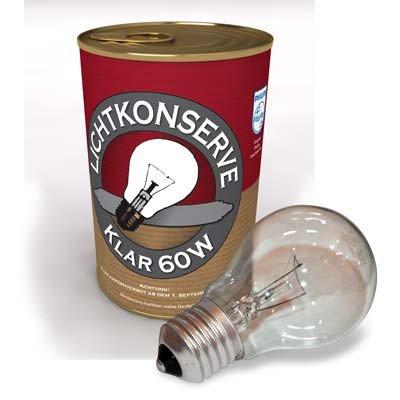
"Licht Konserve" cans too...


They also sell canned Halogens and other products alongside, as seen here.

Also, promotion with online sales at plentino.de, with sales also via cardanlight.com, gebrauchlicht.de and maybe via other sites...

Sales brochure (pdf) here.


Walsroder newspaper article 19.12.2011 by E. Lindemann, as in the press section of Lichtkonserve.de, Google translation modified a bit to make some sense...


Light out of the Tin Can

A rebel from Schwarmstedt conserves light bulbs and sells his own lighting systems.

"I've always plotted my own lighting," says Bernhard Stich. As a trained electrician he was active for many years as a buyer of commercial electric lighting. Cable systems with halogen lights especially excited Herr Strich - but less so the prices.
"So I just built himself such a system," he says. Immediately there was demand from friends and acquaintances - the cornerstone of his company Halogenkauf Lightech was laid. The then 30 year old electrician designed his own home lighting systems, his wife mounted them while watching television, and the sale went through a newspaper ad.

"I have made my hobby into a career," he says. A milestone in the company's history was Expo 2000 in Hanover. "We fitted out about 120 gift shops on the Expo site with lighting systems," the lighting expert recalls. He is also a renowned expert in the lighting of retail stores. A specialty of the company are the furniture stores, for which the company has developed flexible systems.

Bernhard Stich started off with a designer store for lights in Hanover. "I grew into it the last 30 years out of that," says the 53-year-old. Step by step it grew into his current construction company.

The parts for his own lamps Stich initially had manufactured in Germany.

The contact with a Chinese man whom he had met at a trade show finally led to Halogenkauf Lightech being manufactured in China. Several times a year CEO Stich now flies to China and negotiates with producers. If space remains in the shipped containers, then it can happen that a popcorn machine or bamboo flooring also come to Germany and are sold in one of six online stores of the entrepreneur.

Still, Bernhard Stich remains a man of lighting. And that's why he could not just accept the ban on incandescents. His resistance he now does with a witty marketing concept: His firm has unceremoniously packed 60-watt bulbs into tin cans and now sells them as canned light. Already, the cans are to be had via his online business. Of course, Stitch has also secured its own website: www.lichtkonserve.de. Soon, the cans should also be available at gas / petrol stations, hardware stores and other shops.


Licht Konserve do seem to have started later, whether independently or not.
The point about mentioning them here is that they still seem to be selling the cans, with various offers, for anyone interested.
Maybe, as is often the case, the commercially based venture with more legal resources than the artistic based venture?
Or do authorities choose to bully those who can't fight back?!

Remember the Heatball sellers difficulty with the authorities too.
A serendipidity event is that by chance they just communicated that they have also given up the legal battle with Heatball and are now presenting remaining bulbs for posterity... yes, as "Kultur Reserve" :-)   Albeit probably not canned.
Maybe another follow up post, then...


Thursday, August 9, 2012

BULB Fiction Film

Updates 17 July, 18 July, 8 August, 9 August.
Also updated 2014 regarding DVD and online availability.


The documentary portrays the power and machinations of the light bulb industry, as well as the resistance against the "Directive for the regulation of lighting products in private households." It's about the profit greed of the industry and their lobbies, the entanglement of politics, the environmental hypocrisy, and about deliberate misinformation.

It is also about the fundamental question of whether the quality of the visual environment, and thus our quality of life, is subordinate to other concerns. The quality of surrounding light represents a value not to be underestimated, a value that one should not rashly sacrifice at the altar of a feel-good environmental conscience.
A fuller description can be seen towards the end of the post.


Having covered one online video light bulb documentary as originally in German, "The Lightbulb Conspiracy" by Cosima Dannoritzer (note: updated July 23), and indeed the recent Spring 2012 45 min 3Sat TV documentary Ausgebrannt - Vom Ende der Glühbirne (Burned Out - The End of the Incandescent), another one, which covers more issues, is "Bulb Fiction", made in Austria by director Christoph Mayr and by cameraman Moritz Gieselmann, who had the original idea.

Official film website Bulbfiction-derfilm.com, Google translation.
Fuller description of the film, in German, Google translation.

Alternative AustrianFilm site
Full press material in German .pdf format with pictures (alt link).
Similar, in sparser .doc format (alt link), Google translation.
Videotrailers "Trailer & Videomaterial" 14 videotrailers, listed by subject, .mov format
Audio clips "Soundbites", by the film director etc, .mp3 format
Photos "Bildmaterial", 53 photos from the film.


I originally heard of the Bulb Fiction film via Peter Stenzel in Vienna, Gluehbirne.ist.org website, which has good information and updates, including other trailers related to the film listed according to subject matter treated: in German, or with Google text translation.

This first video nicely introduces and summarizes the film.

Thanks to Howard Brandston for the tip about it, while Kevan Shaw of Savethebulb.org makes a distinguished appearance in the film itself, and indeed already in the trailer where he sees how bulbs are dealt with (not) at a supposed collection site!


The full 1 1/2 hour video below.

While of limited interest to English only speakers, it does contain some English language interviews and much graphical and other obvious information.
There is a DVD version via Amazon here. I am not aware of any English dubbed or subtitled version.

The original website (http://www.bulbfiction-derfilm.com/) has been abandoned and film-maker Moritz is linking to an online version, doing same below - it can also be seen via Vimeo here


Listing of the participants (bulbfiction-derfilm.com/protagonisten)
[or see Google translated English page version]


My translation of the film synopsis adding some own comments within the [ ] parenthesis:


2007 sees Greenpeace destroy 10 000 light bulbs in front of the Brandenburg Gate in Berlin with a road roller.
The same destruction would not have been possible with "energy saving" bulbs: The mercury contained in 10,000 CFLs is enough to contaminate 50 million liters of drinking water - apart from the acute health hazard for activists and bystanders.

Why Greenpeace together with the lamp industry in Brussels exerted considerable pressure to ban the bulb, is one of the questions pursued in BULB FICTION, the investigative documentary by Christoph Mayr.
[In the film, and in part 2 of this trailer (.mov), Dr Klaus Stanjek, researcher and filmmaker (Cinetarium.de, bilingual site) tells how he was commissioned by Greenpeace Hamburg to investigate the Fluorescent bulbs, but he found them to be energy wasting rather than saving. The study in German, functional English version (link credits, Peter Stenzel, Kevan Shaw). Not exactly what was "required"!]

From September 2009, incandescent lamps of 100W bulbs or more, are banned - like all frosted incandescent bulbs regardless of wattage.
From September 2011 the 60W lamp types disappear, and from September 2012 other regular incandescent types.
Mains-voltage halogen lamps have a grace period and are then banned from autumn 2016.
[EU regulations in more detail, Ceolas.net/#li01inx]

How did we get here?
The industry needs sales, NGOs must prove to their donors that they can put their concerns into visible action, while the majority of politicians just look at which way the wind is blowing, for them there is rarely such a good opportunity to be feted as climate change protectors, as otherwise they would be interfering with powerful industries or such lobby interests.

Almost all who deal with the subject of intense light and its effect on people, health professionals, lighting designers, biologists are against the ban on incandescent lamps. But since they don't belong to any of the big lobbies, their protests go unheeded.
In BULB FICTION they have their say.


Already in 2007, the cameraman and lighting designer Moritz Gieselmann heard by chance that incandescent bulbs would be banned from an employee of the lamp manufacturer Osram, but he thought it to be just a bizarre rumor - who could come up with the idea to ban such a well-established and popular product, the simplicity and elegance of the bulb is unsurpassed to this day: A metal mounting of a glowing tungsten wire in a glass bulb filled with inert gas or vacuum - that's it.
[Moritz Gieselmann: Adieu, gute alte Glühbirne, Adieu, good old light bulb]

Then in 2008, with the impending ban on incandescent bulbs becoming news in all media, Gieselmann begins researching, and what he finds gives rise to a growing skepticism about the compact fluorescent lamp. The information in the media is incomplete, and so comes about the idea of making a feature documentary on the subject. The writer and director Christopher Mayr, at first skeptical about whether the topic isn't too dry, is soon enthusiastic, and with Thomas Bogner, there is a dedicated producer, so in the fall of 2011, as the disappearance of the 60W incandescent lamp becomes a reality, Bulb Fiction hits the cinemas.
[Christoph Mayr about the making of the film: in German, Google translation]

By Regulation (EC) 244/2009 of the EU, the ban on incandescent bulbs and therefore the practical necessity of buying fluorescent lamps became official. Christoph Mayr wanted to talk at the time with the relevant EU energy commissioner, Andris Piebalgs. He refuses, pointing out he is no longer in charge of the department of energy. Günter Oettinger, his successor, also refuses, on the basis that he only came into office after the ban [so it had nothing to do with him].
The relevant top official of the EU, Andras Toth, was stopped by his Commission superiors from stepping in front of the camera.
Only Marlene Holzner, spokeswoman for the EU Energy Commission, was allowed to answer the questions by Christoph Mayr. Because she is not very informed about the topic, she brings Andras Toth as an advisory prompter to help answer the questions - but he must not be filmed!

[So much for EU "openness, transparency and willingness to engage in dialogue"... the film also mentions how Osram, Philips, the EU commissioned VITO research organization, and the ELC light manufacturer cooperative (lobby) organization refused interviews]


That CFLs contain mercury, the EU knows full well. The fact that mercury is toxic, they know too, not for nothing were mercury thermometers banned, and indeed in the fall of 2008 in Austria and Germany, mercury thermometers were exchanged with alternatives for free.

The mercury in bulbs can be extremely toxic, is shown in BULB FICTION by the case of the four-year-old Max from Linden, an idyllic village in Upper Bavaria. After Max one night inhaled the gaseous mercury from the operation of a broken bulb, he gradually loses all his hair, even eyelashes and eyebrows, followed by tremor episodes and depression. Dr. Mutter from Constance, a specialist in mercury exposure, diagnosed mercury contamination, responsible in combination with other stress for these symptoms.
[UBA official German testing, on high mercury values from broken lamps, and other problems "DasErste, Plusminus: Glühlampen Verbot - Der Widerstand wächst", 2011 TV-report video in German]

Gary Zörner from Lafu Institute, who has long dealt with environmental toxins, sums it up: "Every tiny bit of mercury makes for a little bit more mental loss" - because it accumulates in the brain and nerve cells are destroyed, even if no limit is exceeded."

The limit of mercury in CFLs is a chapter in itself: it indeed exists, 5mg per lamp, but it isn't monitored. Christoph Seidel, spokesman of Megaman, which claims to be Europe's largest manufacturer of bulbs, says that one must trust the manufacturers, a control based on mutual trust...

VITO, the Belgian institute that has evaluated the lamps on behalf of the EU, reviewed the mercury content of a sample of just 5 (five) items. Here too no one wants to talk with Christoph Mayr.
[The VITO report: one of the five bulbs is seen to be over the limit at 6.4 mg, while some are only 1-2mg]

Dr. Georg Steinhauser, radiation physicist at the Technical University of Vienna, such a sample size is laughable and simply not serious. He determined to BULB FICTION the mercury content of a compact fluorescent lamp and criticized the official measurement method of the EU, which measures only the mercury adhering to the glass, but not the gaseous form, which escapes when the lamp is stripped down [for testing]: "It's as if to determine the amount of helium in a balloon I were to judge it on the basis of what adheres to the skin of the balloon."

VITO, which otherwise produced very optimistic results for the proponents of the ban on incandescent bulbs, estimates that 80% of the mercury from spent bulbs ends up in the environment.
[The film show that the EU Commission knew this from the VITO material presented to them, before a decision was made.
VITO "optimism" was surpassed by the Commission's own researcher Paolo Bertoldi in his final report, emphasising the "great savings" from directly pushing CFL replacements, more: Ceolas.net/#euban]

Once Europe is covered with compact fluorescent lamps, at least a million of these little poison containers must be disposed of every day. Multiplied by 5mg for each lamp, that means 146 tons of mercury spread everywhere in Europe.

But even the fifth of the burned-out bulbs which arrive intact at recycling plants, can do damage: Christoph Mayr does some film recording at the "Electrical Waste Recycling Group" in Huddersfield, England. The company was in June 2010 sentenced to a fine of 145,000 pounds, because of the mercury contamination of 20 employees, including a pregnant woman, from a long period of ventilation exposure of mercury. A former employee of the company says in the film that he one year afterwards still suffers from poor concentration, memory problems and depression.
[On Mercury clean-up and disposal procedures, Gad Giladi, former president of the Professional Lighting Designers Association is interviewed. He has a good paper covering this and other issues "Phasing-out” the Incandescents – Is the Public Misinformed or Disinformed?"]


Christoph Mayr does not let up.
Bulb FICTION leaves no question about saving light bulb and lamp unanswered.
In Berlin, he speaks with Helmut Höge of TAZ, who for a long time has extensively investigated Phoebus, the light bulbs cartel, founded in the 1920s. Phoebus was the first global cartel. It not only ensured the participating companies, including Osram, Philips and General Electric, profit margins and market share, it also ensured that the service life of incandescent lamps, 1500 hours during Thomas Edisons time at the end of the 19th Century, [2500 hours by 1924, 5000 hours in later examples] was comprehensively reduced to 1000 hours by 1935 [and has remained a 1000 hour standard] For member companies whose bulbs lasted too long there was an elaborate system of fines.

[Also in the film, interviews about the Phoebus (Phöbus) cartel with researcher Markus Krajewski - more about the Phoebus cartel and the continued manufacturer cooperation leading up to the incandescent ban in the USA as well as the EU, see http://ceolas.net/#phoebuspol]

In the early 1990s, Dieter Binninger, inventor and industrialist from Berlin, developed a light bulb that held the same performance as the conventional 1000-hour lamp, yet lasted for 150,000 hours. Just days after he has submitted a bid via a Trust for a former East German lamp factory, he died 1991 in a plane crash. The cartel researcher Rudolf Mirow wrote in 1992 to Birgit Breuel, the head of the Trust: "There is reason to believe that the same cartel members have now carved up the market of the new German federal states between them ..." In 1993, Mirow died in a car accident in Indonesia.

[The Binninger bulb sounds too good to be true, and this seems so.
The patent referred to in the film is DE 3001755C2. Can be looked up on Depatisnet, http://depatisnet.dpma.de, German Patent Bureau, Text of patent Verfahren zur Verlängerung der Lebensdauer von Allgebrauchsglühlampen
A comment on the patent, as from Rudiger Appel, 3Quarks.com Hamburg, here, and other sources:
Basically, the criticism is that the life increase is by lowering the voltage, but power consumption (and presumably the current) rises to maintain the same brightness, so the cost increases too. To replace a standard 100W incandescent light bulb with a Binninger bulb of the same luminosity, supposedly needs 150 W of electrical power. an increased consumption of 50 kWh, at a price of 0.20 € / kWh that is 10 € for the 1000 hrs of a normal bulb....
Interestingly, the opposite of raising operating voltage and lowering current for given wattage also increases lifespan while reducing the light output, eg some "rough service" type bulbs.
Also, US 110 volt mains operated 100W standard bulbs are brighter than European 220 volt mains ones, being closer to 150W European, but have 750 hr standard life compared to 1000 European (pre-ban), though of course other production factors like filament thickness etc may enter into it.
However, as the film says, long-lasting incandescent bulbs of all kinds have been kept from ordinary consumers, and recent incandescent energy saving inventions have not been pursued by major manufacturers either, given the more profitable switchover lighting alternatives]


BULB FICTION also discusses the biological and medical aspects of light, there are significant differences in the quality of light from regular incandescent light bulbs and that of fluorescent lamps.
Incandescent light bulbs are known as thermal radiators: A tungsten filament is heated until it emits light, analogous to the sun and fire. And as with the natural sources the light and heat are inextricably linked, so it is with the bulb. But when the lighting industry in the 1930s was looking for a technical-physical definition of light, it reduced the term "light" to the visually perceptible fraction of the sun's radiation. That infrared light, the invisible part of this radiation, has an effect on our organism is not disputed. What side effects the absence of infrared light can have, is still largely unexplored. Professor Richard Funk [website] is on the board of the Anatomical Institute of the University of Dresden. In 2009 he published a study in which he puts forward the hypothesis that blue components in light from new lighting sources, which are unaccompanied by infrared, can contribute to the emergence of macular degeneration in the eye. In experiments, he demonstrates that blue light can damage retinal cells, however, infrared stimulates cells to repair themselves.

[Funk, Wunsch, Lachenmayr Makuladegeneration & Energiesparlampen, Macular Degeneration & Energy Saving Bulbs The fact that fluorescents, as in the film, demonstrably lacks infrared radiation is typically commented "hey, look, no heat waste from them!" - as for example in this German ARD TV program "Kopfball" video (second half) - forgetting that the CFL heat output (80% v 95% incandescent) is internalized in the ballast, giving the greater unpredictable fire risk from the bulbs http://ceolas.net/#li18eax.
Moritz Gieselmann adds on his website "There is also a psychological factor: Since in the spectrum of light bulbs, the red components are underrepresented, the person perceives his environment as cool - and turns the heating up."
As Halogenica comments on the subject, this may also be a factor why resistance to the ban is greater in Northern Europe, the incandescent reddish warm light spectrum not desired in warmer climates, where people anyway spend less time indoors in smaller living areas and have less dark winters etc, http://ceolas.net/#li11x - frosted incandescent light bulbs, the first to be banned, are also much more popular in Northern than in Southern Europe, as I was informed by Osram and Philips sales departments]

The light of fluorescent lamps is missing not only in the infrared region, they have 3 or 5-energy peaks in the visible spectrum range, with darkness in between, as the physician, Dr. Alexander Wunsch, who has extensively looked at the health aspects of light, demonstrates.
The result is also poor color rendition - because objects can only reflect the light with which they are illuminated in the first place. From the lack of certain colors in the light, surfaces in these colors appear pale and washed out.
[More: Alexander Wunsch, Ja zur Glühlampe Google translation, from his Lichtbiologie (Light Biology) website]

Wolfgang Maes, building biologist from Neuss, tests the CFL on behalf of Ökotest, with startling results: The value ​​of the electromagnetic pollution is up to 15 times higher than allowed by the TCO standard for screen displays.

[Wolfgang Maes also demonstrates that CFL flimmering and flickering has not disappeared with the electronic ballasts as supposed, it is just not visible to the naked eye.
His paper Die dunklen Seiten der Energiesparlampen, summarized as a newspaper article, good run-through of CFL issues, the pdf document texts can be copy-pasted into Google etc translation services.
CFL brightness: Mr Maes measurements, like others, show the common CFL to incandescent 1:5 wattage assumption (eg 15W CFL supposed to be as bright as a 75W bulb) is more like 1:3 or generously 1:4
The film also points out that CFLs lose brightness with use, and interestingly, how old people's yellowing eye lenses absorbing blue light means the CFL's appear still dimmer to them]


In Brussels, Christoph Mayr speaks with Holger Krahmer [Holger-Krahmer.de, translated], a German MEP from Leipzig, who spoke out as the first European politician against the ban on the incandescent light bulbs. For him it is incomprehensible as being part of democratic politics, that it is politically decided which products may be used by citizens and which may not. The ban reminds him of the dictatorial planned economy of the GDR that he experienced [Leipzig is in the former East Germany]. Also a lot seen on a specific trailer (.mov) of his contribution.

Max Otte, financial journalist and professor of economics: "This Europe is a Europe of big business, that long since took over the reins of power!"

In the meantime, Sigmar Gabriel, German Environment Minister, allegedly one of the driving forces behind the ban on incandescent bulbs, handed out thousands of compact fluorescent lamps from Osram in the last federal election campaign.


Unswervingly Christoph Mayr pursues the investigative leads, meticulously all the details on the subject are edited together.

How to find the nearest collection point for electronic waste?
Not always as easy as one might imagine. Is really everything done to avoid the toxic mercury escaping into the environment?
(Kevan Shaw goes with a neatly packed fluorescent bulb to a disposal site... no prize for guessing what happens]

Do the high values given to the life expectancy of CFLs really hold up?
[No, as Kevan Shaw also points out... the reasons include that on-off switching in real life exceeds the 3 hour lab test cycles, and that brightness decreases with use, shortening effective lifespan]

Is the so-called quicksilver paradox true, that mercury-free incandescent bulbs are actually responsible for more mercury release into the environment via coal power plants than the mercury-containing compact fluorescent lamps are responsible for?
[No, and never was, for many reasons, Ceolas.net/#li198x, Kevan for example pointing out how some coal mercury remains fixed in the burned ash and chimney (flue) wall]

What is the Heat Replacement Effect?
[The replacement by incandescent heat of room heat generated from other sources, the film mentions UK research (more on the topic http://ceolas.net/#li6x) and also how the effect increases with modern buildings... ironically all todays "energy saving insulation" as in ceilings and attics, increases such energy saving heat benefit, while use with air conditioning cooling of course is optional and might be preferred anyway for light quality etc reasons]

And what effect will the mercury lamps have for people in developing countries?
[The film illustrates with the situation in India, Christoph interviews Ravi Agarwal, founder of Toxics Link, amongst others who themselves report that Indian CFL industry puts consumers at great risk, average content per CFL found to be 21.2 mg, much higher than international standards... the film also shows how CFLs are openly dumped]


At the end of BULB FICTION the makers of Heatball [Heatball.de, smaller English version] present their campaign, turning the argument on its head that light bulbs give off 95% of the energy as heat radiation, in order to sell bulbs as small heaters that just happen to give off some light:
"Heat Ball is also a resistance against the disproportionality of measures to protect our environment. How can you seriously believe that we help save the planet's climate by using energy saving light bulbs, while allowing rain forests to wait in vain for decades for any real protection?"
The European-German bureaucracy are out of their depth in adequately trying to deal with these engaged citizens and their performance art, resorting to public order mandates, financial penalties, and seizure of the Heat balls.


Bulb Fiction,
is a film for engaged citizens who are not satisfied just to be angry about what is happening, but want to be better informed, helping them reach a more educated opinion of what this is all about.


Film Director Christoph Mayr sums up the experience...
end of his statement, my translation.

Having intensively pursued the subject, I am convinced that [EU] industry representatives, in our case the light bulb manufacturers, carefully plan what they do and are aware of the dangers of compact fluorescent lamps. I am equally convinced that the manufacturers try on the one hand to hide these dangers, and on the other hand to downplay them, should they become public.
The findings from my research are applicable in other areas. The topic "Energy saving light bulbs" is a great way to show the methods and the cold-bloodedness of major industries.

Is Bulb Fiction therefore a film about lamps? No, Bulb Fiction is a film about power and the abuse of power, about people who oppose large, powerful institutions, big corporations, and big government. Bulb Fiction is a film about moral courage and mature conduct. The film wants to be a dissenting voice to the already well underway mighty million costing advertising campaigns of the lamp industry, a voice of enlightenment, if you will.

Bulb Fiction tries nothing less than to bring light to the truth.

Christoph Mayr, September 2011


The Heat Ball campaign mentioned has been covered in several posts here,
the main ones being the last one here, and this here, "We want to shed more heat than light!", from which also the following...

"All the lads" behind the two ventures

Rudolf Hannot (Heatball), Christoph Mayr (Bulb Fiction), Siegfried Rotthäuser (Heatball),
and Moritz Gieselmann (Bulb Fiction)


How Regulations are Wrongly Justified
14 points, referenced:
Includes why the overall society savings aren't there, and even if they were, why alternative policies are better, including alternative policies that target light bulbs.
 

Saturday, August 25, 2012

Canned Heat
"Das kleinste Birnendenkmal Europas"


No, this is not about these guys...


Rather about something with a less blue-sy content...


or if you will...


[Seemingly the same idea has occurred to different creators...
The ones covered here claim to be first and to have been copied, as per comment! Some more about the "Lichtkonserve" canning of light bulbs will follow.
Update: See "Whatever You Can, We Can Too"...]


The Heatball satirical objection to the bulb ban has been well covered in previous posts, and is still ongoing through all the legal challenges and appeals.
Meanwhile another satirical artistic venture has been going on for some years, although recently halted, again for legal reasons (the ones without humor are the German judges, but in that profession they are not alone!).
This is about the Frankfurt based Canned Heat venture, or rather Kultur-Reserve, culture reserve, by the Metermorphosen company: a word play on "metamorphosis",
as they focus on creating new artistic meaning out of everyday objects.


Their own description of their activities: Google translation, somewhat corrected...

MeterMorphosen stands, as already seen in the name, for transformed everyday objects.
We develop our own product ideas, check their feasibility, and then produce them with the most suitable materials. The transformations are more than just a gimmick, they give the items a palpable new dimension. Thus a yardstick measure of space became a measure of time and space. Or from the linoleum floor a memory card game was made, with original artwork from the 1920s. And from the world's most widely used eating utensils a small collection of poems, with which you can combine the sensuality of eating with the sensuality of poetry.
Important for MeterMorphosen is a playfully educative approach, the products must have a certain esprit, the abstract becoming sensually comprehensible. By such lateral thinking our products may succeed to make complex inter-relations more clear and able to be seen in a new way.


They also have an English language presentation of themselves...


While the canned bulb manufacture and sales have been organized by publisher Florian Koch and partners, the concept and also apparently the original manufacture was by artist Lutz Jahnke in Offenbach.


There seem to be slightly conflicting accounts about it, but the story seems to go something like this...
During the lighting festival Luminale in Offenbach April 2010, Lutz Jahnke and his partner Julia Diehl organized a big "Birnen Denkmal" light bulb memorial to incandescent light bulbs:
Public collections of spent bulbs took place and mounds of them were artistically arranged by Lutz, Julia and others.
Seemingly now in 2012 there are plans for some kind of repeat offering - the original idea and further development will be covered in a following blog post.


Having got access to sausage making /canning machines the idea then came to Jahnke
about extending the memorial idea... "after the biggest light bulb memorial in Germany, the smallest light bulb memorial in Europe!".
A "culture reserve", not really supposed to be opened, an artistically produced memory of today's bulbs for the future.

Lutz had several lines of thought behind it...
Birne = Pear = what former German leader Chancellor Kohl was called, also the classic bulb in cartoons being synonymous with a "bright idea", also historically the bulb reaching back a long time, given the action as a kind of memorial, while also symbolizing a resistance to government interference in personal freedom, the "last ration" aspect of putting it in a can, as in survival shelters...

So he started putting the bulbs into cans, somewhere along the line getting
help with the manufacture and distribution by the Metamorphoses company in Frankfurt.


Op-Online 10/4/2012 article about artist Lutz and the canned bulb development:
[or see Google translated English version]


The presentation of it as a product for sale:
[or see Google translated English version]


The site however also now warns
"The culture reserve product is until further notice not deliverable and can not be ordered from the online shop".....


The canned bulbs become banned

In recent months, the venture has again got media coverage in Germany.
14th July article from the Frankfurter Runsdschau paper, translated.

A fuller account from the 25th July, 2012, also from artist Lutz Jahnke's point of view
op-online website, translated.

As can be seen, the sale is now forbidden under threat of a 2000 Euro fine for a first offence (somewhat like drug dealing), the argument being that such 60W bulbs were banned from manufacture Sep 2011.
Lutz and company manager Koch - reasonably enough - feel they were really only packaging and distruibuting already made bulbs. The bulbs came first from German, then from French manufacturers, before the ban.
In the EU, like in the USA, the legislation is of not allowing further manufacture within the jurisdiction, or import from outside, of the light bulbs - neither of which apply here.
Florian Koch said that they may yet beat the new deadline of 1 Sep 2012 for 40W bulbs by filling cans with them instead... however, to date this seems not to have occured.

Videos:
Recent videos carry the same tale about the ban on the sale.
For example, July 24 2012, on the RTL Hessen site: mp4 file, featuring Florian Koch.

Another video from July, from the 25 minute point, featuring Lutz Jahnke, also describing how he got the idea after getting hold of a sausage machine.


Lutz's concluding thoughts from his Jahnke design site

01 september 2012:
glühbirnen — europaweit verboten
»nichts bewegt die welt mehr als licht — deshalb haben wir ihm ein denkmal für alle nostalgiger & ein mahnmal für alle die immer noch wahllos energie verschwenden, gewidmet.
die »kultur reserve« ist die antwort auf die faulen früchte der eurokratie. ein zeitgenössiches kunstwerk, das sie unbedingt in ihren besitz bringen müssen.«

01 september 2012:
incandescent bulbs - banned throughout europe
"nothing moves the world more than light - that's why we dedicated to it a monument for all with nostalgia and a memorial for all those who still (choose to) indiscriminately waste energy.
The "cultural reserve" is the answer to the bad fruits of the eurocracy, a contemporary artwork that they absolutely have to bring into their possession."